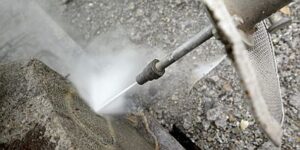
Ultra-high-pressure (UHP) water jetting uses a plain stream of water, pressurised above 1,000 bar, to remove material from a surface. No chemicals, no abrasive grit, no thermal input. The cleaning power comes from the kinetic energy released when a small volume of water hits the surface at very high velocity.
Pressure, flow and the trade-off between them
Two figures define every water jetting system: pressure, measured in bar, and flow rate, measured in litres per minute. A pump delivers a fixed amount of hydraulic power, so the two work against each other. Raising the pressure at constant power means reducing the flow.
The practical consequence is simple. High pressure with low flow gives an aggressive, concentrated cut that removes hard, well-bonded deposits. Lower pressure with high flow moves large volumes of soft material quickly. Choosing between them is the first decision in specifying a system.
- 500–1,000 bar — general industrial cleaning, degreasing, surface washing.
- 1,000–2,500 bar — tube and heat exchanger cleaning, tank cleaning, coating removal.
- 2,500–3,000 bar — concrete hydro-demolition, hard scale, rubber and polymer removal.
Why water instead of abrasive blasting
Abrasive blasting is effective, but it introduces spent grit that has to be collected and disposed of, and it embeds particles in the substrate. Water jetting produces no secondary waste beyond the water itself and the removed material, which can usually be filtered and separated.
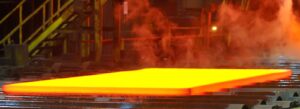
It also does not generate sparks, which matters in refineries, tank farms and any environment with a flammable atmosphere. And because the process is cold, there is no distortion of thin metal and no heat-affected zone.
For surface preparation before coating, water jetting removes soluble salts that abrasive blasting leaves behind — one of the most common causes of premature coating failure.
Typical applications
The technology is used wherever a deposit has to come off without damaging what is underneath:
- heat exchanger and boiler tube cleaning;
- storage tank cleaning and sludge removal;
- pipeline and sewer cleaning;
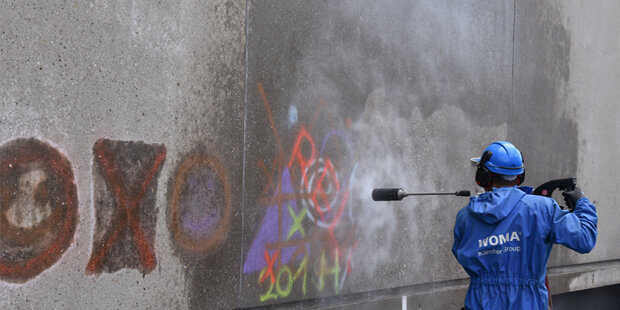
- paint and coating removal from steel structures and ship hulls;
- concrete hydro-demolition and rebar exposure;
- mould and production line cleaning in chemical and food plants.
Specifying a system
Start from the deposit, not from the pump. Establish what has to be removed, how strongly it is bonded and what the substrate can tolerate. That determines the pressure band. Then calculate the area to be treated per shift — this determines the flow, and therefore the drive power.
From there, the practical questions follow: is the work fixed or mobile, is electrical power available on site, is the atmosphere classified, and can the operation be automated with a lance robot or crawler rather than being handled manually?
Safety is not optional
A UHP jet will cut through skin and bone in an instant, and the injury it causes is often deceptive — a small entry wound hiding severe internal damage. Every operation requires trained operators, correct protective equipment, exclusion zones and a documented risk assessment. Automation should always be preferred where the geometry allows it: the safest operator is the one who is not in the jet path.
Working with Forajet
As the Turkish representative of WOMA (Kärcher Group), we supply UHP pumps, accessories and automated tooling, together with commissioning, operator training, spare parts and service. If you are evaluating a water jetting application, tell us what you need to remove and from what — the equipment selection follows from there.