Before a protective coating goes on, the steel underneath has to be clean. Two methods dominate: abrasive blasting and ultra-high-pressure water jetting. They are not interchangeable, and choosing between them is rarely about cleaning power alone.
Soluble salts — the decisive difference
Chlorides and sulphates left on a surface draw moisture through the coating film and cause blistering and under-film corrosion, often within a fraction of the expected coating life. Abrasive blasting removes rust and mill scale efficiently, but it does not remove soluble salts — it can drive them deeper into the surface profile.
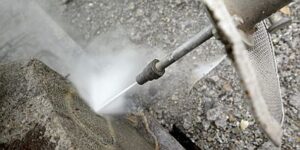
Water jetting dissolves and flushes them away. Where a structure has been in a marine or chemical environment, this single property usually decides the method.
Surface profile
Abrasive blasting creates a profile by cutting into the steel. Water jetting does not create a new profile — it exposes and cleans the one that is already there from previous blasting. On maintenance work this is usually an advantage: repeated blasting thins the steel over the life of a structure, while jetting does not remove parent metal.
On new steel with no existing profile, and where the coating specification requires a defined anchor pattern, abrasive blasting remains necessary.
Waste and containment
Blasting generates spent abrasive mixed with the removed coating — often several kilograms of hazardous waste per square metre. Water jetting produces water plus paint solids, which can be filtered so that the solids are collected and the water reused or discharged after treatment. On lead-based or otherwise hazardous coatings, the difference in disposal cost is substantial.
Spark and dust risk
Abrasive blasting generates sparks and airborne dust. In refineries, tank farms, offshore installations and any classified area, that alone rules it out for much of the work. Water jetting is cold and spark-free, and it suppresses rather than raises dust.
Flash rust
The one drawback of water jetting: clean bare steel oxidises within minutes of being wetted. Light flash rust is acceptable under many coating specifications, but the grade has to be agreed in advance, and the coating must be applied within the stated window. Corrosion inhibitors can be added where the schedule demands it.
How to decide
- Existing profile in serviceable condition, maintenance repaint → water jetting.
- Marine or chemical exposure, salt contamination suspected → water jetting.
- Classified or spark-sensitive area → water jetting.
- Hazardous existing coating, disposal cost critical → water jetting.
- New steel needing a specified anchor profile → abrasive blasting.
- Coating specification that does not permit flash rust → abrasive blasting, or jetting with inhibitor and a controlled schedule.
Working with Forajet
We supply WOMA ultra-high-pressure equipment for surface preparation in Türkiye, including automated tooling for tanks, decks and structural steel. Send us the coating specification and the condition of the existing surface, and we will work through the method and equipment with you.