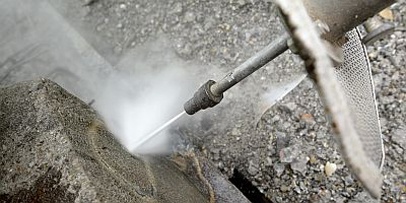
Repairing a concrete structure starts with removing what has failed. The traditional method — pneumatic breakers — is loud, slow and, more importantly, it damages what is meant to stay. Hydro-demolition solves that by using a high-pressure water jet instead of impact.
Why impact damages the structure
A breaker works by transmitting shock into the concrete. That shock does not stop at the boundary of the damaged area. It propagates into the sound concrete underneath, opening micro-cracks that are invisible at the time of the repair but become the starting point of the next failure. It also bends, notches and work-hardens the reinforcing bars.
Water jetting removes material by erosion, not impact. The jet finds the weakest path — the deteriorated, porous, chloride-contaminated concrete — and leaves sound material behind. There is no shock loading of the structure.
Selective removal
This selectivity is the defining property of the method. Concrete that has lost strength is removed at a given pressure and traverse speed; sound concrete at the same setting is not. In practice this means the excavation stops naturally at the sound substrate, rather than depending on the operator’s judgement.
The reinforcement is cleaned in the process. Rust and scale are stripped from the bar surface, and the bar is left with its section and profile intact — ready for the repair mortar without further preparation.
The surface you are left with
Hydro-demolition produces a rough, irregular, three-dimensional surface with an exposed aggregate profile. This is precisely what a repair mortar needs for mechanical bond. A breaker leaves a smoothed, micro-cracked surface that has to be prepared again before the repair can be applied.
Practical considerations
- Water management — the process uses significant volumes of water, which must be collected, filtered and, because contact with fresh concrete raises its pH, neutralised before discharge.
- Reaction force — hand lances are limited by what an operator can safely hold. Above that, robotic units are used, which also removes the operator from the jet path.
- Noise and vibration — considerably lower than breakers, which often decides the method on bridges, car parks and occupied buildings.
- Productivity — removal rates are measured in cubic metres per hour rather than by area, and depend on the concrete strength and the depth required.
Where it is used
Bridge decks and soffits, quay walls and marine structures, car park slabs, cooling towers, industrial floors and any reinforced structure where chloride or carbonation damage has to be cut out before repair.
Working with Forajet
We supply WOMA ultra-high-pressure pumps and hydro-demolition equipment in Türkiye. If you have a repair specification, send us the concrete strength, the removal depth and the area — the pump and tooling selection follows from those three figures.